When a motherly hug is the best medicine
 By Niamh Hooper

Monday November 12 2007
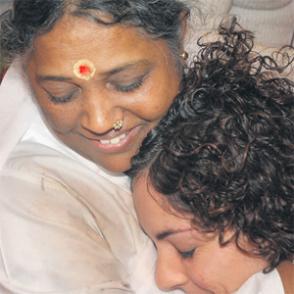
With four hugs a day prescribed for survival, eight a day for emotional strength and 12 for growth, what would scientific research make of Amma?
Known fondly as The Hugging Saint, she is said to have hugged more than 26 million people from all races, religions and walks of life all over the planet. This week she’s in Ireland for a two-day hugathon.
Over the past few years, thousands of Irish people have made pilgrimages to see the visiting bones of St Anthony and the relics of St Teresa, so it’s a bit of a novelty having Amma arrive here — not in a dusty casket, but in a simple white sari, glowing with smiles and ready to dispense hugs until everyone who wants one has got one.
In her native India, 54-year-old Mata Amritananda Mayi often sits for 20 hours without a break and would hug up to 30,000 people in a day.
Power of a hug
Nobody, it seems, can resist. So what is it? Is it the hugs themselves or does the power come from this Indian woman who was abused as a child and is now esteemed as an Incarnation of the Divine Mother?
She’s also an internationally-recognised humanitarian and spiritual leader, and has been presented with numerous prestigious awards previously won by Nelson Mandela, the Dalai Lama and Kofi Annan.
Ever since I can remember, I’ve reckoned hugs and ice-cream are a panacea for all ailments. But, unlike Haagen Dazs, hugs contain no calories.
They’re 100pc wholesome, natural and free. They’re warm, comforting and can say all that needs to be said where words can’t.
Asked in interviews why she hugs, Amma has said that is like asking a river why it flows. “That is my character. My karma (destiny) is to console those who are sad.”
Often likened to Mother Teresa, Amma (which means mother) is regarded as the epitome of universal motherhood. Her message of love, compassion and tolerance has united people of all nationalities, religions and colours. But it is her willingness to be available to anyone who wants to meet for a hug that appeals most.
“Selfishness dominates the world. Everybody wants to take but nobody is willing to give. Hugging someone is a symbol of giving. It expresses love, of which there is not enough in this world,” she has said.
No matter where she goes, thousands of people will wait however long for their turn — it could be as much as six hours.
There are stories of miracles occurring in huggees. While I can’t say I noticed a miracle, it’s pretty powerful. Since I first had a hug with Amma four years ago, I’ve gone back every time she’s returned to Ireland.
My first experience of darshan, as this hugging blessing is called, was on a Saturday morning in a crowded RDS.
Everyone was in their socks and there was Hindi music playing. Amma was taking person after person into her lap or to her breast and holding them. Whispering words of Malayalam, the tongue of her native Kerala, she gently caressed and blessed them.
When I was about third from the top of the long queue, for no apparent reason my body started shaking and tears trickled down my cheeks.
Kneeling before this unique woman with the tiniest feet and the seriousness of a schoolgirl, she took me to her lap, uttered Kerala words which were lost on me and held me until the shaking subsided.
Scent of roses
My senses filled with her scent of roses and her dancing eyes looked deeply into mine, before she placed a sweet in my hand and released me beneath a shower of petals.
It’s hard to explain the feeling present when Amma is there — Antoine de St Exupery’s words in The Little Prince, “What is essential is invisible to the eye”, spring to mind.
When people join the queue, if they want to give Amma a donation they can give a flower (and as a sign of respect they do not smell the flower before presenting it).
The money from these and all the stalls goes to Amma’s NGO, which has special UN status. In addition to offering people living in poverty access to hospitals, universities, schools and housing, it provided a $23m programme after the 2004 tsunami.
More than 300 volunteers will be co-ordinating the fourth annual programme in Dublin, which includes the opportunity to receive an individual embrace.
The programme at the National Show Centre in Cloghran starts tomorrow at 9.30am. PS. Bring a cushion.
Darshan How does it work?
The facts
Born in the small village of Parayakadavu, near Kollam, in 1953, Amma’s schooling ended when she was nine and she began to take care of her younger siblings full-time.
Since 1981, she has been teaching spiritual aspirants all over the world. Deepak Chopra has described her as “the embodiment of pure love. Her presence heals”.
Yolanda King, daughter of Martin Luther King, said of Amma: “Her example of non-violence as a means of raising the human condition reminds me very much of my father and Ghandi.”
The Evidence
Medical professionals will attest that babies who are not touched enough can die from Failure To Thrive Syndrome. Hugs are an antidote to the adult equivalent.
A study conducted at Princeton University confirmed that babies who are frequently touched in a loving manner until they are 12 years old are much more likely to be intimate and loving in future relationships.
– Niamh Hooper

 The 1,300-bed Hospital comprises six medical speciality institutes, more than 30 departments and 10 specialist laboratories. “From 1998 to 2005, AIMS and all the healthcare institutions run by Amma’s Ashram treated 2,097,099 people. During that time, we provided Rs 149.70 crore ($34,022,727) worth of free medical care; 7,51,098 patients received completely free treatment,” states Dr Prem Nair, Medical Director.