
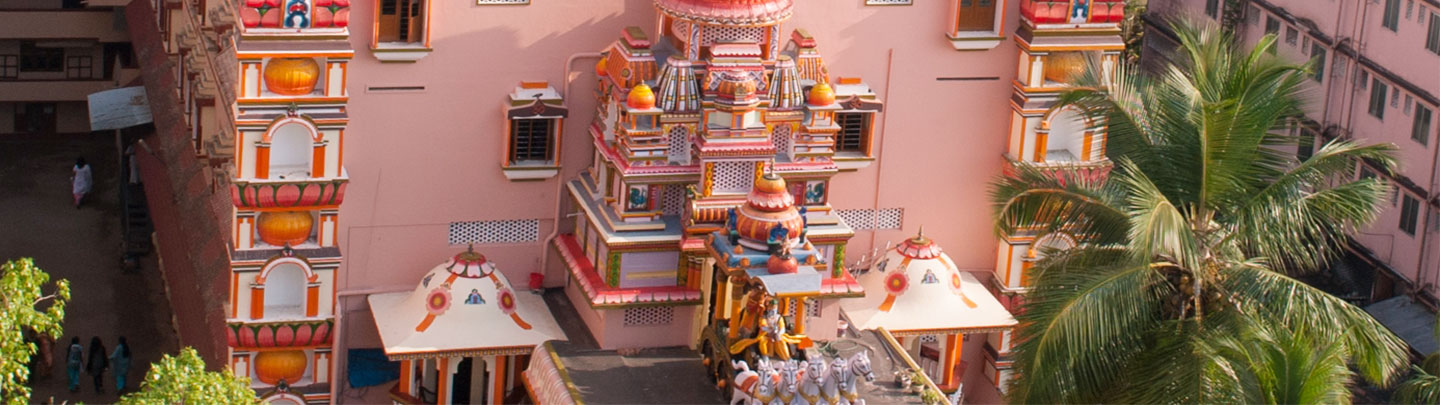
The sound of bells can be heard everywhere in India. They ring to signify special events, festivals, a call to prayer, or to mark the passage of time.
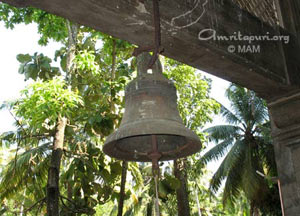 So, of course, there are many bells in Amritapuri. The two main bells, both about a foot tall are located in the Temple and in the Main Hall. In the morning, they are rung three times each starting first at 4am (wake up time), again at 4:30, and lastly at 4:50am for the start of Archana. The sounds of the bells carry across the silence of the Ashram – signalling to everyone that a new day has begun.
Whenever Amma comes out for Satsang or Darshan, a third bell is rung along with the other two. It sounds sort of like a buzzer, or like the bell signalling the end of recess in school. Whenever these are rung, there is a flurry of white as everyone rushes towards the hall to get a seat near Amma.
There are other bells – the original bell at the Kalari (in the early days it was the only bell at the Ashram), which is rung during special pujas; and one in the Inner Temple which is rung when the doors to the Sanctum Santorum where Kali is kept are opened or closed. And we can’t forget the small cow bell in the Western Canteen which is rung three times before chanting the prayer before each meal.
Then there are the hand bells rung by the pujari in the Kalari, or by the Brahmachari/Brahmacharini waving the camphor in front of Amma’s photo or the Kali Murthi; and the kaymine bells played during Bhajans.
Whenever Amma is not in the Ashram, morning Archana and evening Bhajans are held separately for men and women. Men sit on the stage in the Main Hall, and Women gather in the Temple. At the end of Bhajans, one can often hear many of these bells ringing simultaneously. If one happens to be in earshot of both groups, the sound is wonderful – a cacophony of celebration. The solemn ring of the main bell, the sycophated ringing of the hand bell, the feverish playing of the kayminies. Add the voices of the women, and the men – and one can hear and feel the joy of devotion, the reverence, the love for Amma.
And sometimes, if the boys have finished Arati first, we can hear the girls’ bell still going over the lingering silence on the stage. Sometimes it’s the other way around. But no matter who finishes first, in the end, there is one last bell heard – ‘Jai Bolo Sat Guru Mata Amritanandamayi Devi Ki…..’
Jai!
Audio: Listen to the end of the Brahmacharinis singing Arati while the Brahmacharis are just beginning on stage.
–Sri Pati
Leave a Reply
You must be logged in to post a comment.